04 / Independent game product teardown · First 50 levels
50 LEVELS.
ONE QUESTION.
How does a simple puzzle loop become a much larger product ecosystem?
A player-perspective teardown of Toon Blast, tracing how onboarding, progression, timed events and social prompts enter the experience. These are observations and product hypotheses—not claims about the game's internal data or strategy.
01 / The core loop
Easy to enter.
More to learn.
Core gameplay & retention systems
- Core loop
- Play → Learn → Try → Progress. New mechanics enter through contextual prompts.
- Surrounding systems
- Timed events, social incentives, boosters and rewards observed around the loop across the first 50 levels.
A summary of this teardown's observations — not the game's internal model.
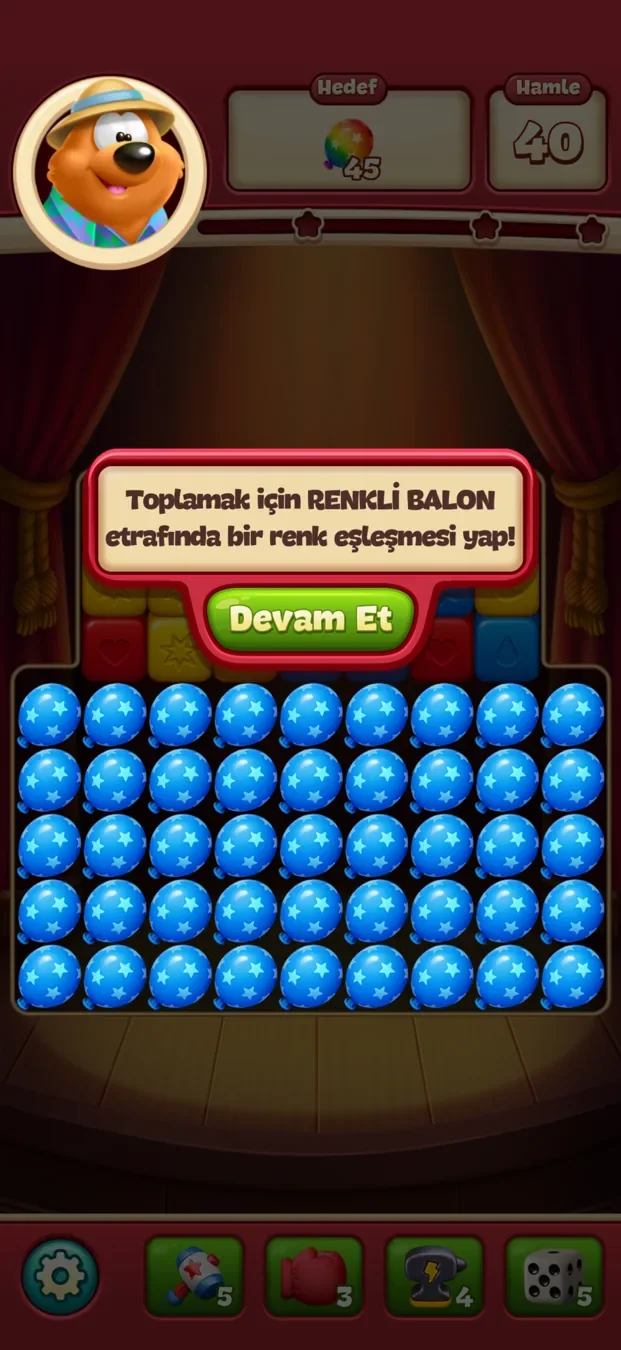
A balloon mechanic explained at the moment it becomes relevant.
The basic match-and-clear interaction is understandable quickly. Additional tile mechanics are introduced through contextual prompts rather than a dense explanation up front.
Teach in context, not in a manual.
The tutorial connects a new objective to an immediate action. This may reduce the amount of information a player must remember before acting.
Keep new mechanic introductions short and test whether players understand the rule after the prompt disappears.
02 / LiveOps discovery
The home screen is
an event hub.
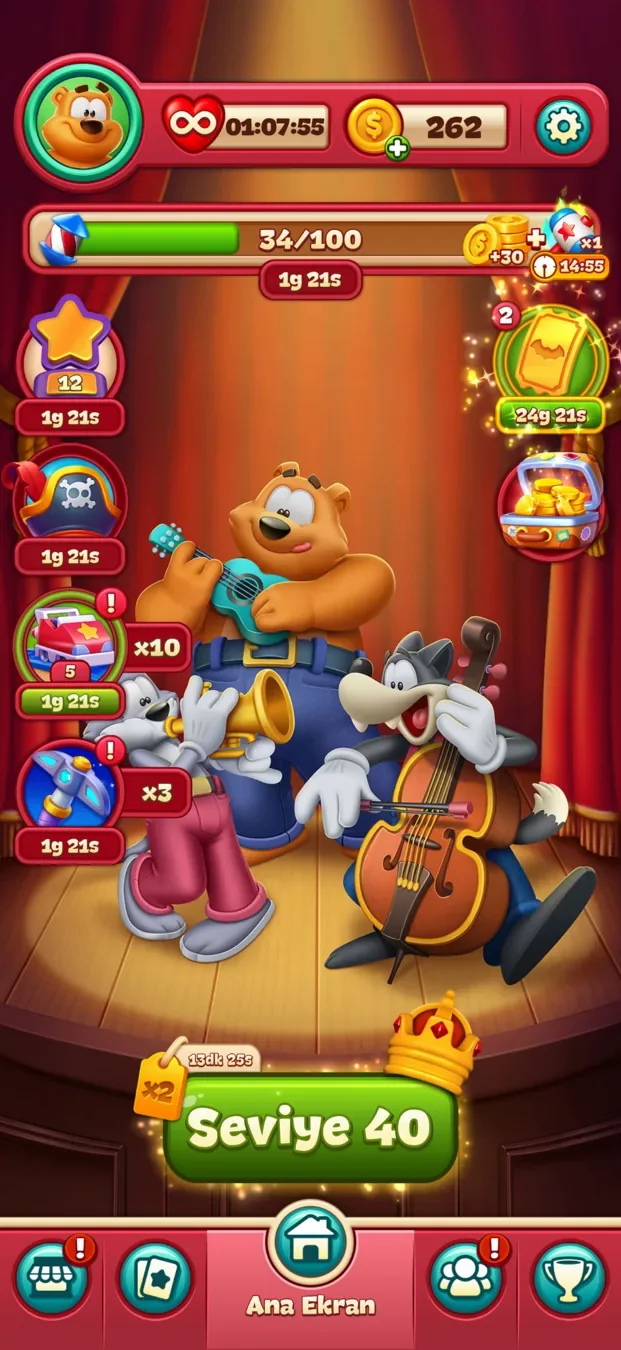
Multiple event surfaces surrounding the primary level action.
The home screen presents multiple time-limited activities at once. Countdown labels, progress bars, reward icons and notification badges compete for attention alongside the primary level button.
Visibility creates urgency—and complexity.
Timed content gives players additional reasons to return, while several simultaneous entry points can make it harder to know what matters next.
Explore a clearer hierarchy between the next level, active event progress and secondary promotions.
03 / Event onboarding
One event.
A second progression loop.
The Space Miner event introduces its own instructions, tool resource, board and reward path. It adds a short-term objective outside the main puzzle progression.
Main puzzle progression
- ANext level
- BClear the puzzle
- CAdvance on the level map
Space Miner · event loop
- 01Learn the event-specific action
- 02Tool resource
- 03Event board
- 04Reward path — and the next resource constraint
Product hypothesis
A separate event loop may extend session goals beyond clearing the next puzzle. Its value should be evaluated against comprehension and cognitive load.
04 / Social & competitive retention
Progress can become
a shared outcome.
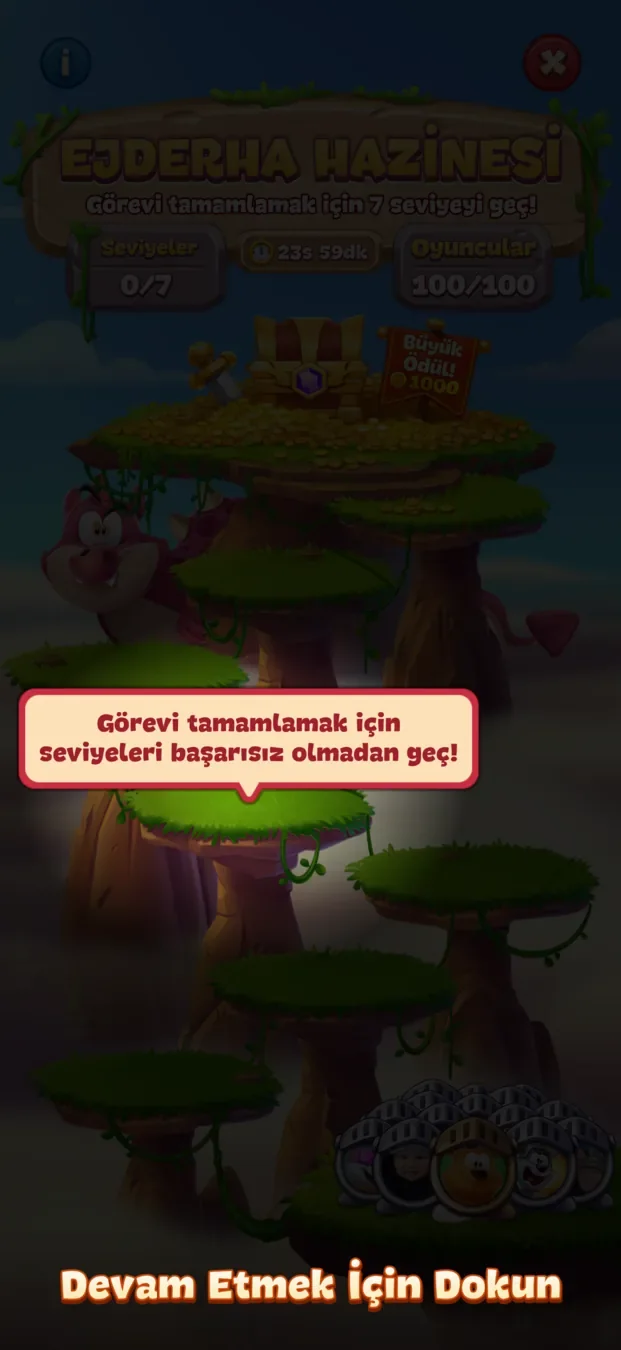
Seven levels, no failure
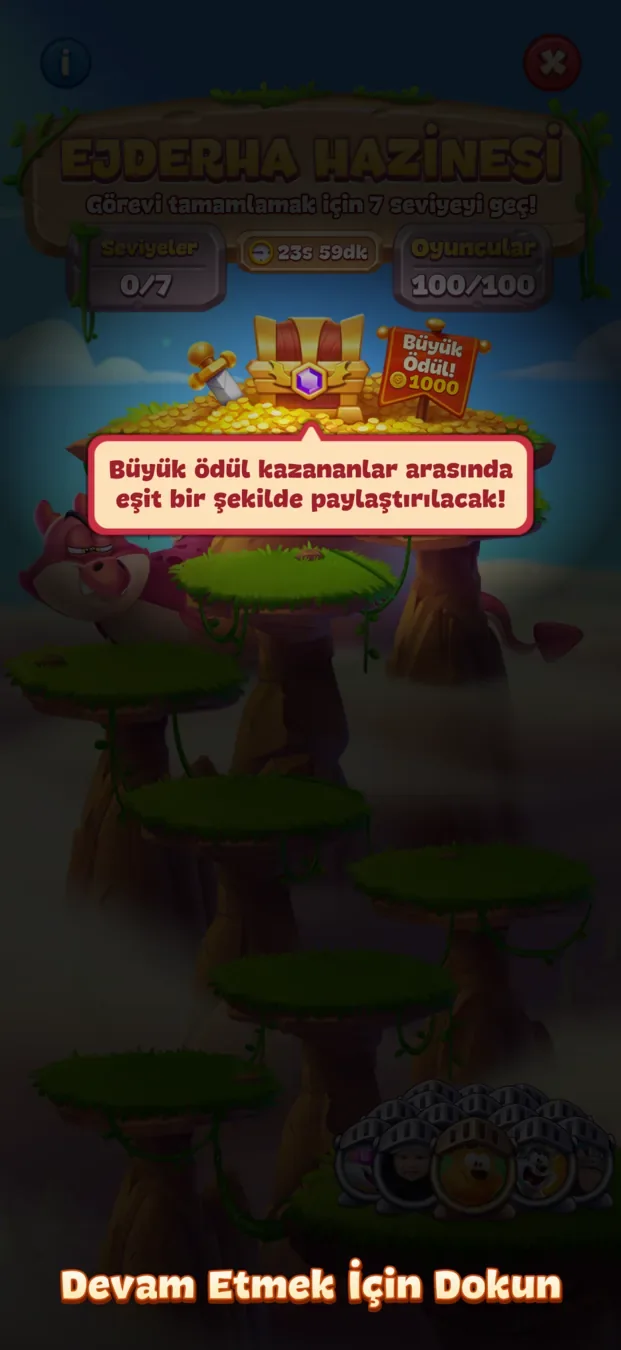
A prize shared among winners
Observation 04Dragon Treasure combines a win streak objective with a shared reward.
Dragon Treasure presents a seven-level, no-failure challenge and a prize shared among winners.
A reward is no longer only personal.
The framing introduces competition and a collective outcome without changing the core puzzle interaction.
Make participation rules and reward distribution easy to understand before a player commits.
05 / Return & community prompts
Beyond the level map.
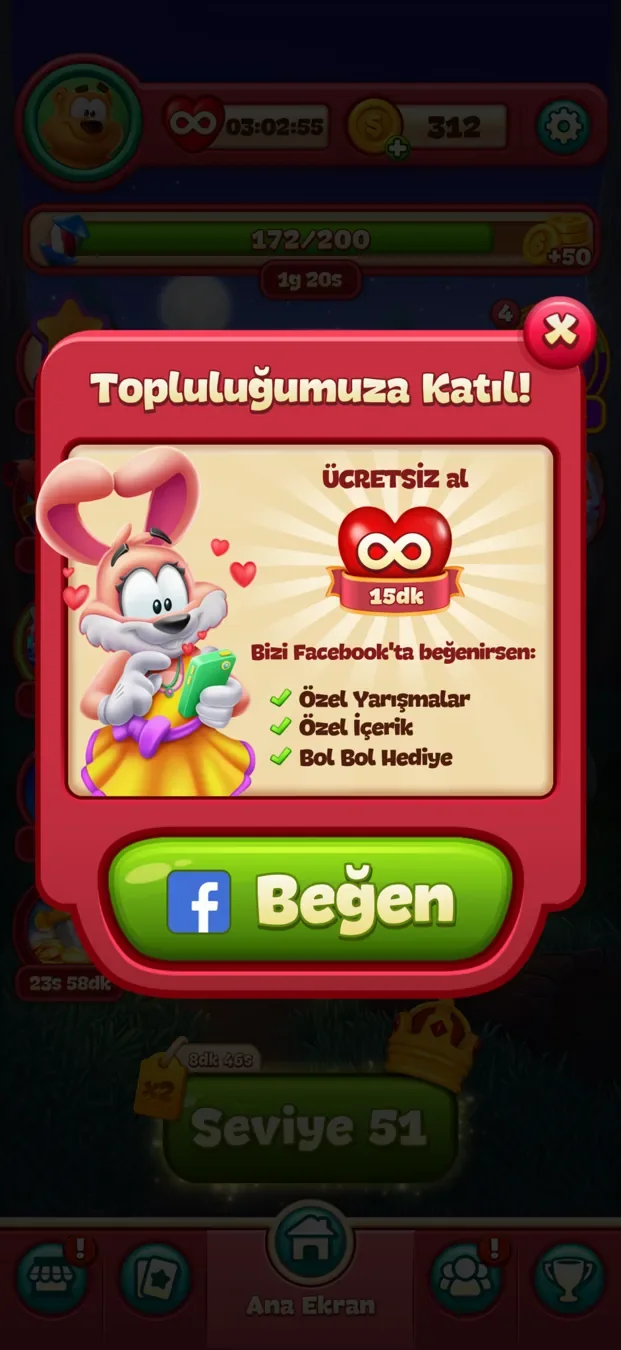
An external community invitation offering in-game benefits.
The observed experience also includes prompts for an external Facebook community. This is a visible bridge from in-game activity to an out-of-game social space; its actual conversion or retention impact cannot be inferred from screenshots.
Give each prompt a clear purpose.
The community invitation highlights free timed lives, competitions, content and gifts. Players may understand the benefits, but the interruption should be weighed against where it appears in the play journey.
Compare prompt timing and dismissal behavior rather than assuming a prominent offer is always more effective.
06 / Difficulty & support systems
When a level gets harder,
what helps the player continue?
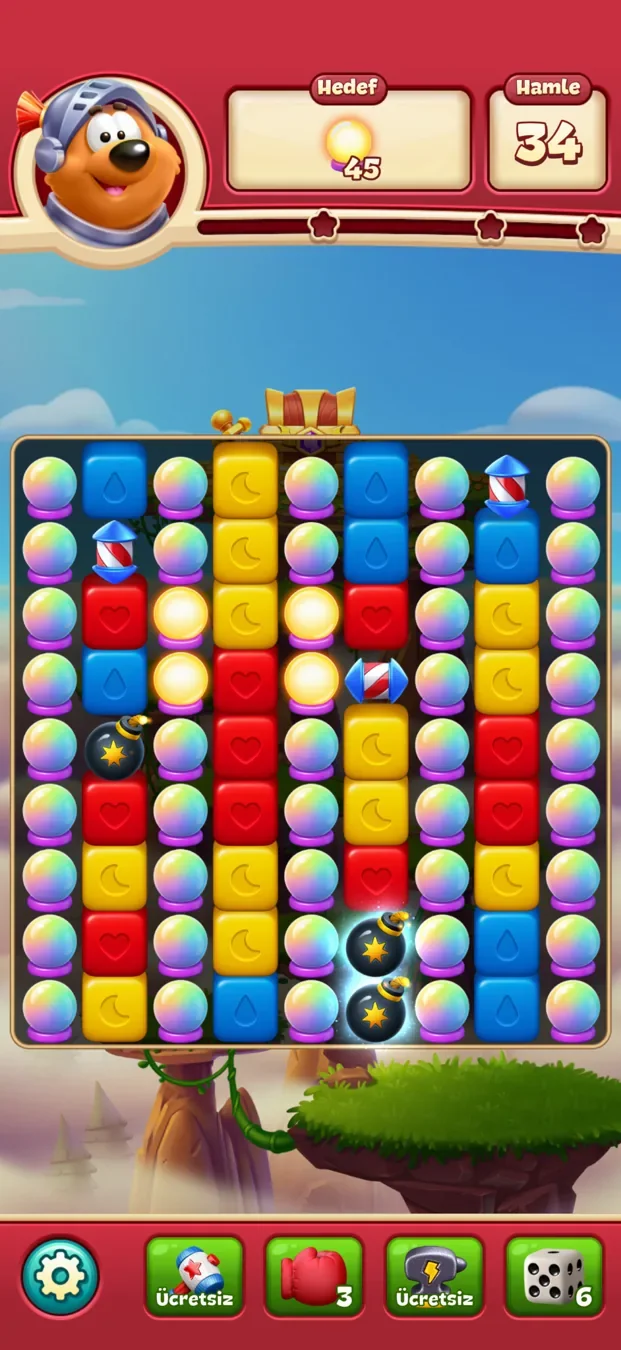
A level in progress, with booster options shown below the board.
Boosters and support tools add options beyond the basic match-and-clear action. Their presence creates a product question: does the game teach players when and why to use a tool, or merely show that the tool exists?
Support should build confidence, not confusion.
As mechanics accumulate, players must learn both puzzle rules and the role of available boosters. The perceived difficulty of a level can therefore depend on how well those options are understood.
Test whether first-time booster prompts improve comprehension, and compare level retries with and without contextual support. These are proposed experiments, not measured results.
07 / Progression & feedback
Progress needs
an understandable meaning.
Illustrative — shows the question, not observed values.
The level journey combines completed stages, visible stars and several parallel progress systems. Progress indicators can motivate continued play, but their value depends on whether players understand what each one represents.
Make the relationship between action and reward legible.
When the role of stars or an event meter is not immediately clear, the interface can create a question instead of a goal.
Review how stars are introduced, whether rewards are explained at the point of earning, and how event progress is communicated after each level.
08 / Monetization & returning players
More reasons to return.
More decisions to make.
Timed lives, rewards, boosters and multiple events suggest different ways the experience can shape session length and return behavior. They also sit near monetization-related decisions, where the distinction between earned progress, free support and paid value matters.
Product questions, not internal claims
Protect the clarity of the core journey.
- Monetization
Is the value of a booster or purchase understandable before a player needs it? Are free and paid paths easy to distinguish?
- Returning players
After time away, can someone identify the next useful action without processing every event badge and timer?
- Opportunity
Evaluate return-session comprehension, offer timing and perceived fairness through usability testing and behavioral data if available.
The product takeaway
The puzzle is the entry point. The surrounding systems shape the journey.
Across the first 50 levels, the most interesting shift was not the basic puzzle interaction. It was the gradual addition of new mechanics, boosters, rewards, timers, events and social incentives. My main product question: how do you keep these systems discoverable without obscuring the simple loop that brought players in?
Independent observational analysis based on personal gameplay. No access to internal analytics, experiments, or product decisions. Screenshots are used for commentary and critique; Toon Blast and its artwork belong to their respective owners.